
-
Latin America
Latin America
- Countries (hidden space)
- Galapagos & Ecuador
- Guatemala
- Mexico
- Panama
- Peru
- Popular Attractions
- Machu Picchu
- Inca Trail
- Easter Island
- Galapagos Islands
- Patagonia
- Rio de Janeiro
- Iguazu Falls
-
Africa
Africa
- Spacer Africa
- South Africa
- Zimbabwe
- Popular Attractions
- Cape Town
- Okavango Delta
- Sossusvlei Dunes
- Victoria Falls
- The Kruger
- The Garden Route
- Masai Mara
-
Asia & Middle East
Asia & Middle East
- Asia
- Borneo (Malaysia)
- Cambodia
- India
- Japan
- Middle East
- Jordan
- Spacer Asia
- Laos
- Sri Lanka
- Uzbekistan
- Vietnam
- Popular Attractions
- Taj Mahal
- Lion Rock (Sigiriya)
- Angkor Wat
- Ha Long Bay
- Kyoto
- Petra
-
Destinations
- Latin America
- Argentina
- Bolivia
- Brazil
- Chile
- Colombia
- Costa Rica
- Galapagos & Ecuador
- Guatemala
- Mexico
- Panama
- Peru
- Asia
- Borneo (Malaysia)
- Cambodia
- India
- Japan
- Laos
- Sri Lanka
- Uzbekistan
- Vietnam
- Middle East
- Jordan
- Southern & East Africa
- Botswana
- Kenya
- Namibia
- South Africa
- Zimbabwe
- Contact Us
-
About
About
Llama Travel provides high quality holidays at the lowest possible prices.
99% recommend us Lower prices - guaranteed Financially protected by ATOL
What makes Petra so special?
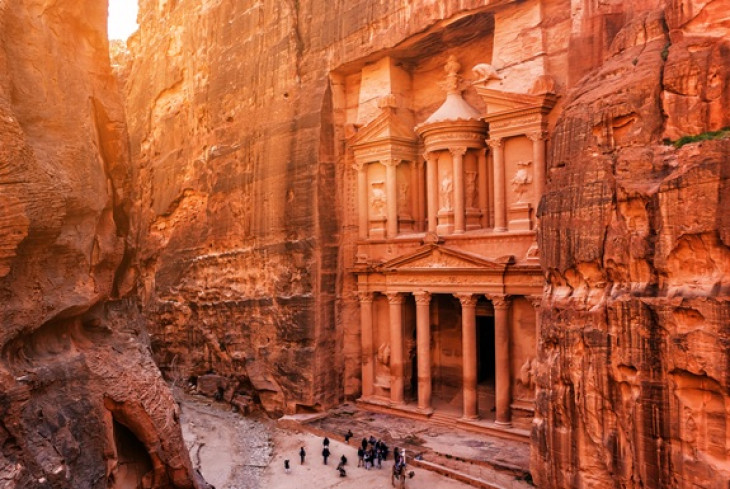
Petra is undoubtedly a highlight of any holiday to Jordan. Carved into a sandstone valley in the Shara Mountains, there are many reasons why this millennia-old city is so remarkable, spanning its construction, abandonment and rediscovery to its frankly ingenious waterworks.
This blog will explore just a few of the reasons why Petra earned UNESCO World Heritage status in 1985, was named one of the New Seven Wonders of the World in 2007, and is renowned as one of the most unique landmarks on Llama Travel holidays.
The architecture
The most distinctive feature of Petra is undoubtedly its unique architecture. Centuries on from its construction, it is still regarded as one of the world’s great architectural feats: especially when you consider that ancient Nabataeans carved the soft sandstone structures top-to-bottom while standing on wooden scaffolding or mountain steps, using relatively primitive chisels and hammers.
Many of the Nabataean designers and builders of Petra were nomadic traders who, on their travels, were inspired by the grand architecture of the Greeks, Romans, and Egyptians. The Corinthian columns, arches, and pediments (decorative triangular pieces hung over entrances, famously seen on the Parthenon) evoke the Greco-Roman style, while the obelisks and crowsteps are clearly inspired by ancient Egypt. The tops of columns are blocky, floral and abstract, rather than the ornate carvings of those in ancient Greece, reflecting the Nabateans’ own architectural flair.
Petra’s nickname, ‘the Rose-Red City’, is derived from its colourful sandstone surroundings, the result of mineral deposits in the stone forming swirling red, pink, orange, yellow, and white patterns, only heightening its architectural beauty.
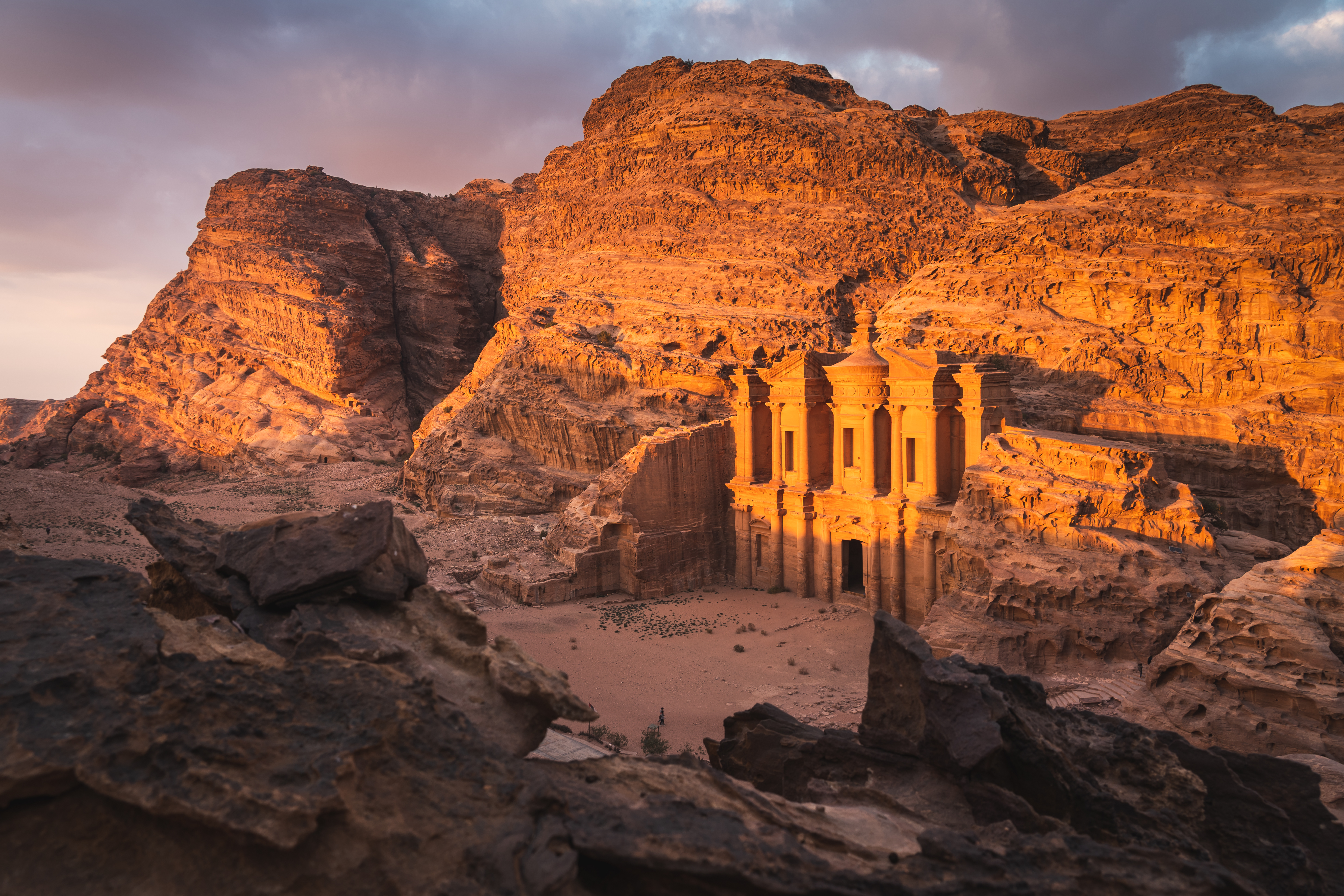
The Monastery, one of the most magnificent structures in Petra.
The water system
Hear us out! While the sheer wonder of Petra’s architecture is plain to see from the outside, its ingenious water system is hidden slightly below the mountainous surface.
An intricate network of terracotta pipes carved into the mountain valley connects Petra to several natural springs—the furthest of which is around 5 miles away. The pipes are on a gentle slope downward from the spring to avoid water pressure building up and bursting the pipes, while safely supplying freshwater to the 30,000-person population who lived in Petra at its peak. Water was preserved in underground reservoirs, essentially acting as a backup plan to provide millions of gallons of water during drought.
On rare occasions when it did rain, certain canyons, including the main entrance or ‘Siq’, were prone to flash flooding due to Petra’s mountain valley location. The Nabataeans built a massive, 13-metre-high concrete and stone dam (which still stands to this day) in 50 BC or so, safely rerouting floodwater to a nearby valley.
The history
The history of Petra is as layered and intricate as its mountain-face structures and water system.
As mentioned, the Nabataeans who eventually built Petra were traders in the 4th century BC, and savvy ones at that. As the incense and myrrh trades grew massively, they eventually settled at a key location along the trade routes: the intersection of the routes from southern Arabia, India, and China to the Mediterranean. The Nabataeans knew that if they could offer a safe haven and resting point for the merchant caravans that passed through, they would become incredibly wealthy.
By the 1st century BC, construction on Petra had been completed, and it quickly became a bustling trade capital, just as the Nabataeans expected. Its wealth and influence grew into the early 1st century AD, when Roman Emperor Trajan annexed the Nabataean Kingdom. Rather than destroying Petra, they expanded it, adding a triumphal arch, theatre and colonnaded street.
Over the next few centuries, the Romans began prioritising sea-based trading routes through the Red Sea and more northern land routes. As these routes were established, Petra’s importance declined. That was compounded by major earthquakes in 363 AD and 551 AD, which led to its eventual abandonment in the 7th century.
For over a millennium, Petra was essentially abandoned, with only local Bedouin tribes aware of its existence. Those tribes kept Petra, and the treasures they expected to lie within, a closely-guarded secret—until rumour spread of a spectacular lost ancient city in the early 19th century.
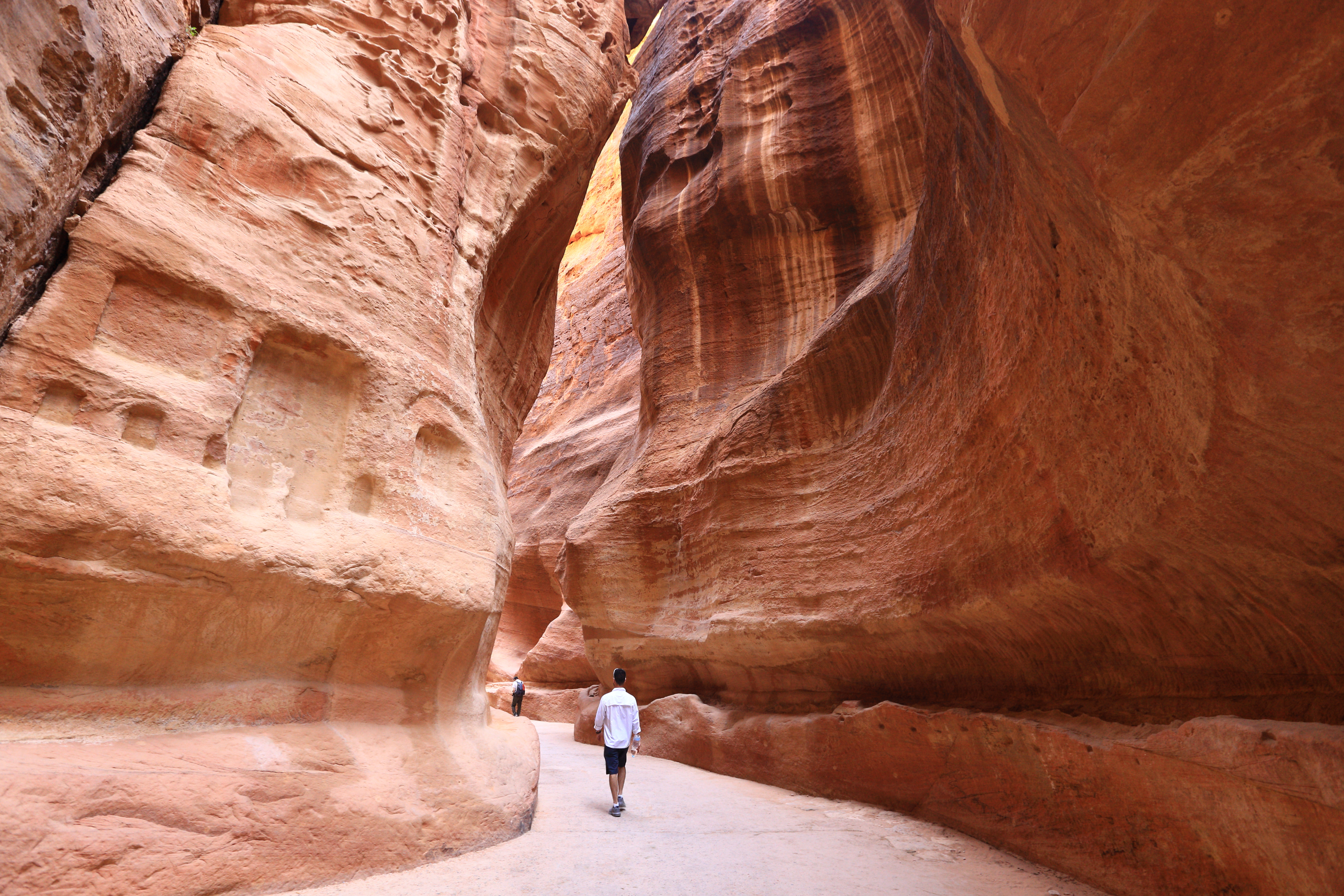
For centuries, Petra was a well-kept local secret, hidden among mountainous canyons.
The 'discovery'
Johann Ludwig Burckhardt, a Swiss explorer, assumed a new identity as Ibrahim ibn Abdallah around 1808, before exploring the Islamic east. He learned Arabic and Islamic law to blend in throughout his travels in Syria, Lebanon and Palestine, where he likely first heard of a lost, ancient city.
Upon arriving in Jordan in 1812, Burckhardt tricked a local guide into taking him to Petra under the auspices of needing to sacrifice a goat at the prophet Aaron’s tomb, which is at the top of a mountain near the site. He arrived there on August 22nd, 1812, becoming the first Westerner to set eyes on Petra. He mapped some of the site before fleeing, fearing that local tribes would consider him a treasure hunter. He eventually revealed Petra’s existence to the rest of the world in his travel memoirs in 1822.
Burckhardt’s ‘discovery’ of Petra soon saw explorers, artists and archaeologists rush to the site, shortly followed by tourists. Since then, it has been incredibly popular, with a notable spike in interest after its designation as a UNESCO World Heritage Site in 1985, an appearance in Indiana Jones and the Last Crusade in 1989, and its recognition as a New Wonder of the World in 2007.
The sheer scale of it all
One of the most iconic views of Petra is of tourists dwarfed at the doorway to the nearly 130-feet-tall Treasury building, which is the equivalent of a 12-storey building. The Monastery stands at over 150 feet in the nearby mountains, with its front doorway alone taller than 9 feet.
While that scale is inarguably impressive, the scale of the entire site is perhaps more staggering. The core archaeological site of Petra covers over 100 square miles and includes around 800 core monuments and more than 500 tombs. Visiting Petra is a full-day experience at the very least.
What is even more impressive about the sense of scale evoked by the vast structures and sprawling archaeological site is what lies underground; experts estimate that around 15% of Petra has been uncovered, with the remainder still buried in the desert sands.
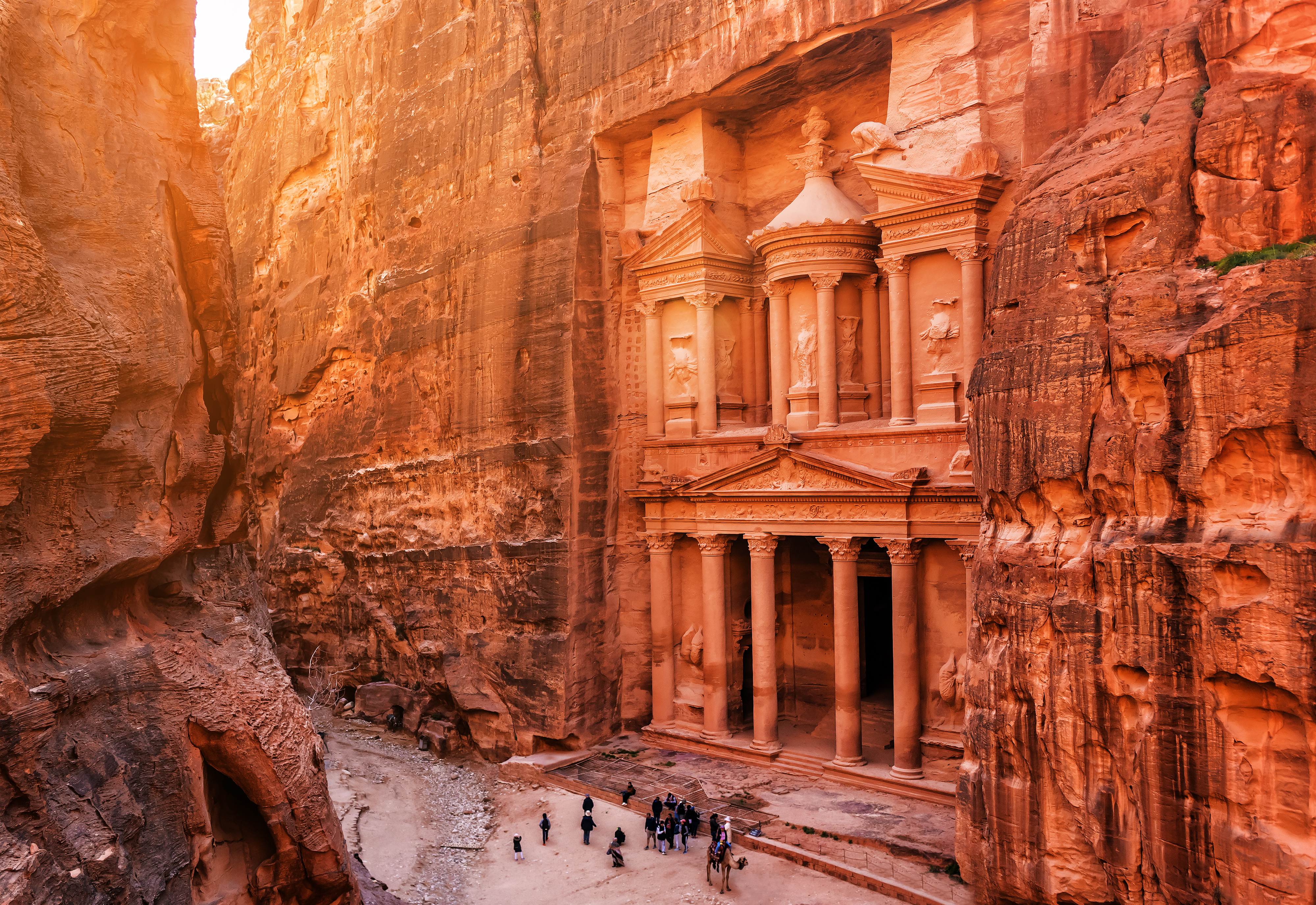
Visitors to Petra are dwarfed by the sheer scale of the site.
All of our holidays to Jordan include a guided tour of Petra and an afternoon to explore the site at leisure. There is also an optional excursion to visit by candlelight at nighttime.
At Llama Travel, we have sold great-value small-group holidays since 2002. Our Jordan holidays reflect the same expertise and great customer service that have seen 99% of our customers say they would recommend us to a friend.
You can browse all of our Jordan holidays here, or make an enquiry and one of our Travel Experts, who has visited Llama Travel’s destinations extensively and knows our holidays in and out, will reach out to begin your holiday planning.